

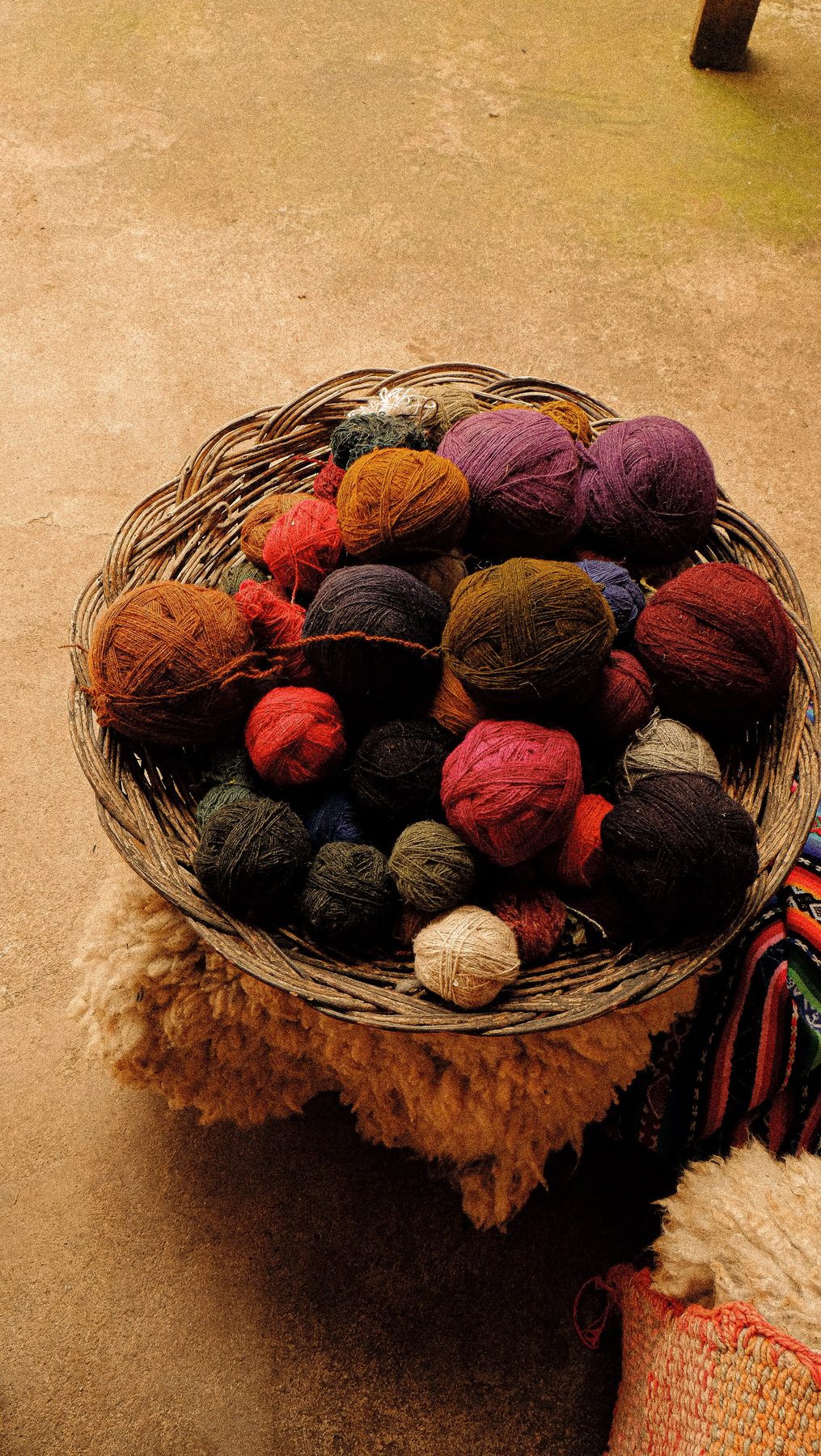
In the Peruvian Andes, weaving is a language. It carries memory, identity, and a heritage passed from one generation to the next, and every thread and pattern holds something of the Andean world. In Chinchero, near Cusco, it is part of daily life, woven into the rhythm of families and the hours of the day. Before a single textile exists, though, there is a long process, one that asks for skill, patience, and pride. This is how it happens.
From fleece to fiber
It begins with wool. Sheep, llamas, and alpacas give their fleece, which is washed, traditionally with a local root called saqta that foams like soap. Once it is clean and dry, the wool is teased apart into a soft, airy mass, ready to be spun.
Spinning is done by hand, with a wooden spindle called a pushka. The motion is quick and precise, and the thread can be made finer or thicker depending on the piece it is meant for. To make it strong enough to weave, two threads are then twisted together on the pushka.
This work never really stops. Women spin while standing, sitting, walking, talking, or watching over their animals. It is common to see a Mamita turning her pushka between her fingers almost without thinking, a small constant motion that holds an entire craft inside it.
The colors of the earth
Andean textiles are known for their color, and much of it comes straight from the land. Reds are drawn from cochineal, yellows and oranges from the q'olle flower, deep greens from the leaves of the chilca plant. The yarn is soaked in these natural baths, set with fixatives such as lemon juice or alum, and dried in the sun.
For a time, with industrialization, this knowledge nearly disappeared. About thirty years ago it began to return, and today the plants and their dyes are once again passed between weavers and across generations.
Warping, and the principle of ayni
Before weaving begins, the warp must be laid: the lengthwise threads that form the structure of the cloth and carry the pattern. The weavers stretch the threads between two sticks, crossing and counting them with great care, anticipating each color of a design that is still invisible to an untrained eye. It asks for patience and precision.
No one does this alone. Here a principle called ayni comes in, the Andean rule of reciprocity: today I help you, tomorrow you help me. Women gather to stretch and count the threads together, making sure none tangle. Warping becomes a social act, a few hours in which both the cloth and the bonds between people are woven.
Preparing to weave
Andean weaving, known as tejido plano or telar de cintura, the backstrap loom, looks simple and is quietly ingenious. A few elements make it work. The heddles lift and separate the threads. The wooden cross sticks keep the threads in order. The ruque, a pointed llama bone, packs the threads down and lets the weaver's fingers move between them. And the belt around the weaver's waist lets her control the tension of the whole cloth with her own body.
A language of threads
Then, thread by thread, the textile comes to life. Every movement is deliberate, every pattern counted, every color chosen. The patterns are not drawn in advance. They are held in memory and in the hands, learned by watching and repeating, passed down rather than written.
It takes deep concentration, and the repetition carries the weaver into something close to a meditative state, fully in the present. More than a craft, this is a way of being in the world, and a story a people have told across time.
Tradition, and what it faces
Today the art faces real challenges: passing it to younger generations, competing with industrial cloth, and earning fair recognition for handwork. And still it continues, carried by the strength of those who weave the thread between past and future, day after day.
Every piece MamaQuilla carries holds this process inside it: the hours, the hands, the plants, the patience. To understand how a textile is made is to understand what it is worth.